

Key Takeaways
- Motherhood in Barbados in the 1700s varied greatly by wealth, work, social status, and freedom.
- Pregnancy and childbirth relied on midwives, relatives, and community knowledge, without modern prenatal care or hospitals.
- Daily family life centered on preparing food, making clothing, managing the home, and teaching children practical skills.
- Enslaved mothers faced restricted control over their work, family relationships, and ability to care for their children.
- Military wives in Barbados raised families far from Britain while supporting husbands stationed at the island’s garrison.
As a mother myself, I sometimes think about how different raising children must have been before modern medicine and all the conveniences we have today. That made me wonder: What was motherhood like in Barbados in the 1700s?
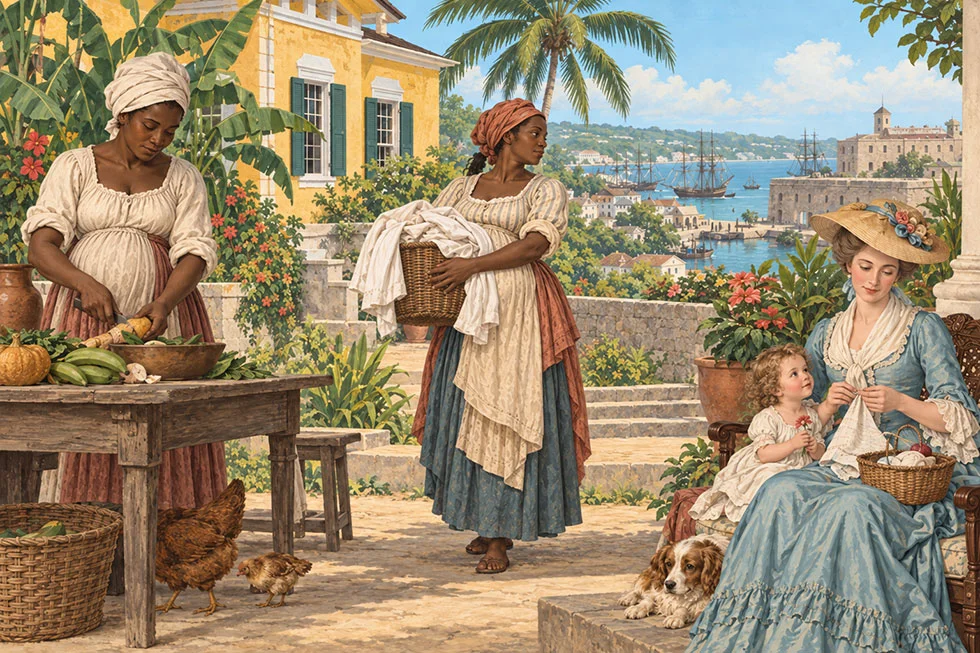
There was no single answer. A wealthy woman living on a plantation had a very different experience from a working woman, an enslaved woman, or a woman who came to Barbados with her husband in the British military.
Their circumstances varied greatly, but mothers still had the everyday responsibilities of caring for children, preparing food, making and repairing clothing, managing a household, and teaching their children.
Pregnancy and Childbirth in 1700s Barbados
Pregnancy and childbirth in Bridgetown and throughout the island were very different from what we know today. Women did not have regular prenatal visits, ultrasounds, or modern hospitals. Much of the knowledge about pregnancy and childbirth was passed from one woman to another.
Midwives, female relatives, and other experienced women could play an important role during childbirth. The care available to a woman often depended on her circumstances. Wealthier families had greater access to household help and medical care, while working women had to balance pregnancy with their daily responsibilities.
Enslaved women faced an entirely different reality. They lived under a system that restricted their freedom and control over their own lives and families. Their experiences as mothers were closely connected to the realities of enslavement.
The historical record does not tell us everything about individual families. However, museums and archives provide important information. The Barbados Museum’s Lascelles Slavery Archive contains records connected to more than 350 family names, including births, deaths, marriages and wills.

Raising Children and Running a Home
After childbirth, mothers had plenty of work. Food had to be prepared from basic ingredients. Clothing had to be made, washed, and repaired. Children needed to be fed, dressed, and watched, while older children often learned practical skills by helping with household work.
There were no refrigerators, washing machines, or modern kitchen appliances. Education also depended on a family’s circumstances. Children from wealthy families could have access to formal education, while other children learned at home or through work and family life.
As a mother, it is hard for me to imagine how much physical work went into simply keeping a household running.
Different Lives for Different Mothers
Social class and status made a major difference in 18th-century Barbados. A wealthy mother might have had servants or enslaved people doing much of the household labor. She could spend more time overseeing her children and teaching her daughters the skills expected of women in her position.
Working women had to balance earning a living with caring for their children and managing their homes. Enslaved mothers had far less control over their lives. They worked under the control of others, and their family relationships could be affected by the system of slavery in Barbados.
Looking at these differences is important. There was no single experience of motherhood in Barbados during the 1700s.
Mothers Who Came to Barbados With British Soldiers
Another group of women had a unique experience: wives who came to Barbados with husbands serving in the British military.
Barbados was an important British commercial and military center with a large garrison. Bridgetown was a busy port, the first stop for travelers from England on their way to the West Indies, and the area known as the Garrison became an important British military site from the 17th century onward. Today, the Garrison is part of the Historic Bridgetown and its Garrison UNESCO World Heritage Site.
For a military wife, moving to Barbados could mean leaving family behind in Britain and starting a household in an unfamiliar place. Women who accompanied military units could also take on work such as laundry, sewing, or nursing while caring for their children.
As a mother, I can imagine how challenging it would have been to raise children far from home while adapting to a new community and supporting a husband in military service.
What About George Washington?
George Washington’s stay in Bridgetown, Barbados, provides an interesting connection to this story.
In 1751, 19-year-old Washington traveled to Barbados with his older half-brother Lawrence Washington, who was suffering from tuberculosis. Lawrence’s wife, Anne, stayed behind. According to Mount Vernon historical records, the couple had already lost three infants and did not want to risk taking their only surviving child on the long sea voyage.
That detail caught my attention as a mother.

Washington was a young visitor to Barbados. I’m sure his mother, Mary Ball Washington, must have worried about him and Lawrence traveling to a far-off island.
While he was here, seeing the island and experiencing life away from home, women were managing pregnancies, children, households, and family responsibilities.
His visit gives us a glimpse into Barbados at that time, but the experiences of the women who lived there tell another important part of the story. When enslaved women gave birth, they were attended to by fellow enslaved persons or white midwives hired by Washington. Concluding that all women definitely had different experiences.
Facts About Motherhood in Barbados in the 1700s
When we think about mothers in Barbados in the 1700s, it is important to remember how much their lives depended on their circumstances.
A wealthy mother, a working mother, an enslaved mother, and a military wife could have very different daily lives. Still, the basic responsibilities of motherhood were familiar. Mothers cared for children, prepared meals, managed homes, and taught the next generation.
For us today, it can be difficult to imagine raising a family without modern medical care, appliances, and the conveniences we rely on every day. The world around these women was very different from ours, but motherhood was still a major part of everyday life in 18th-century Barbados. In general, no matter the situation, motherhood is indeed very special.
So what was it like to be a mother in 1700s Bridgetown, Barbados? It wasn’t easy! You can place yourself back in time and imagine what motherhood was like in the 18th century when you visit the George Washington House.
If you wish to visit George Washington’s House in Bridgetown, Barbados, it is the 18th century home where George Washington lived in the autumn of 1751. It is open for tours from 9:00am – 4:00pm daily, 7 days a week.
Click here or give us a call at (246) 228-5461