

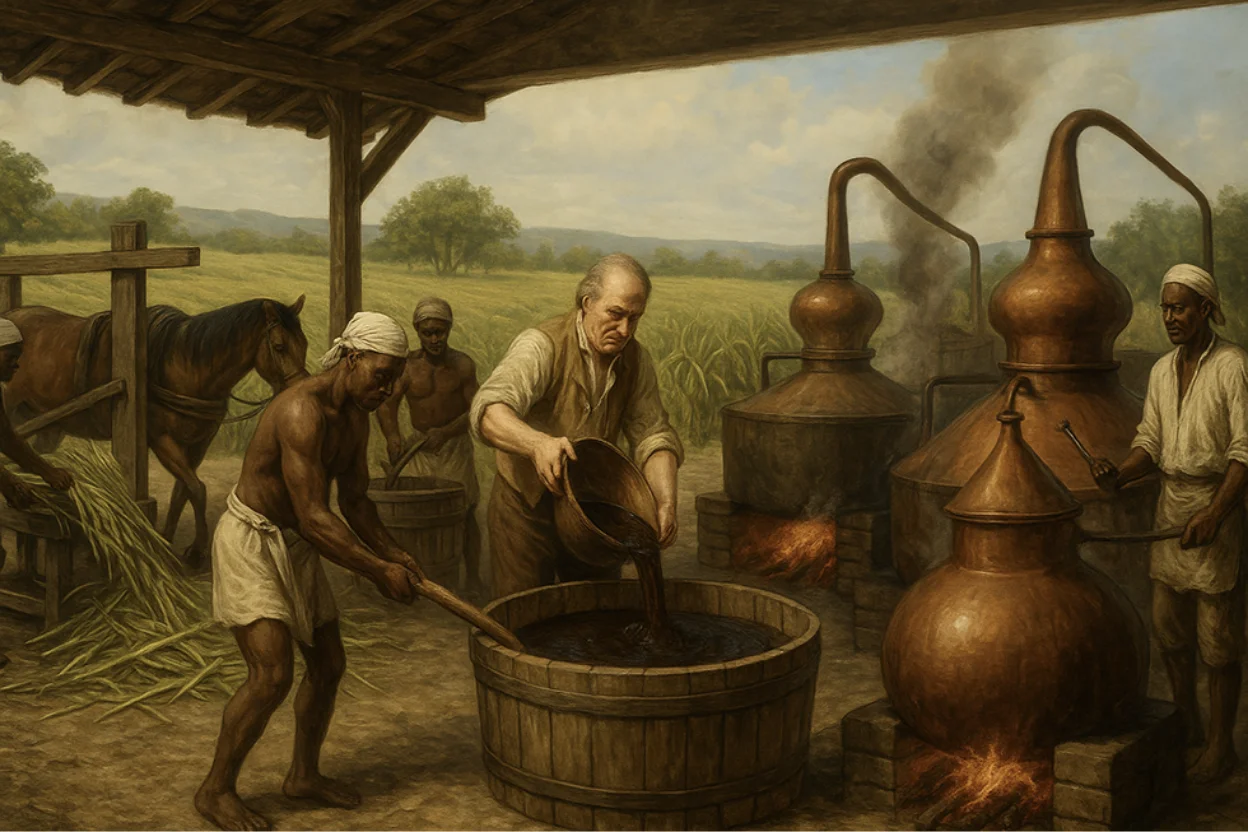
The history of rum in Barbados runs deep. It’s not just a story of sugarcane and stills, it’s the foundation of an industry that shaped global trade and colonial economics. Barbados is widely recognized as the birthplace of modern rum, where distillers refined the craft and exported their techniques across the British Empire.
In 1751, George Washington visited Barbados and saw this booming industry for himself. From sugar plantations to stone cellars lined with barrels, the production of rum was central to island life and commerce.
George Washington was no stranger to rum. He requested that Barbados rum be served at his 1789 inauguration and ordered a full barrel for the occasion. It was a clear reflection of the drink’s popularity and cultural importance during his time.

How Rum Was Made
In 18th-century Barbados, rum started with sugarcane. Plantations harvested the cane and crushed it to extract the juice. The juice was boiled to produce sugar, leaving behind a thick, sticky byproduct: molasses.
Rather than discard it, distillers saw potential in this waste. They diluted the molasses with water and added yeast. This kicked off fermentation, turning the mixture into a weak alcoholic brew.
Next came distillation. The fermented liquid was boiled in copper stills. The alcohol vapor rose, cooled, and condensed into a strong spirit.
Early versions were rough. Locals called it “kill-devil.” But over time, the process improved. The result was a clearer, smoother liquor that became known as Barbados rum.
This spirit quickly became a valuable export—and a symbol of the island’s identity.
Rum Wasn’t About a Celebration for Everyone
In the mid-18th century, making rum in Barbados was as much about economics as it was about taste.
Rum making is inseparable from the brutal legacy of slavery.
As sugar cane plantations flourished across the island in the 17th and 18th centuries, enslaved Africans were forced to toil under inhumane conditions to plant, harvest, and process the cane, a very exhausting and dangerous endeavor.
A Drink That Funded Empires: A Key to the Triangular Trade System
By the time Washington set foot on the island in 1751, rum was already fueling local Caribbean and international economies. The British navy issued daily rum rations for all its sailors, and trade deals often revolved around its production.
In the 18th century, rum emerged as a pivotal commodity in colonial trade, intricately linked to the Atlantic economy and the institution of slavery. Rum became a valuable export for Caribbean colonies, and Bridgetown was one of the hubs.
The economy of Bridgetown was greater than just about any other Caribbean city at the time, fueled in part by the rum trade.
Rum’s production and trade were integral to the triangular trade system, wherein enslaved Africans were transported to the Americas, forced to labor on sugar plantations, and the resulting sugar and rum were exported to Europe and North America. This cycle not only fueled colonial economies but also perpetuated the demand for enslaved labor, making rum both a product and a facilitator of the transatlantic slave trade.
Eric Williams, in his seminal work From Columbus to Castro: The History of the Caribbean 1492–1969, underscores the economic significance of rum within this system. He notes that the profitability of sugar and its derivatives, like rum, was a driving force behind the expansion of slavery in the Caribbean. Williams’ analysis highlights how the colonial pursuit of wealth through commodities like rum was deeply entangled with the exploitation of enslaved peoples.

Understanding this history is crucial to comprehending colonialism’s complex legacy and the rum trade’s enduring impact on Caribbean societies.
While Washington didn’t document drinking himself, he closely studied the port activity in Bridgetown. At the time, rum was shipped out by the barrel alongside sugar and salt cod. The records he kept from his Barbados visit became part of his lifelong observations on trade, colonization, and military supply chains.
George Washington’s visit gave him an up-close look at how this trade functioned. The rum history in Barbados overlapped with shipping, slavery, and trade routes that would later inform how he understood the power of commodities in political strategy and how he understood the strategic power of British shipping.
Why Barbados Was Different
Unlike other islands, Barbados had strict quality controls and export standards early on. Local producers used oak barrels, copper stills, and distilling techniques passed down from European methods. This gave Barbados rum a more consistent reputation than competitors like Jamaica or St. Kitts.
Washington’s exposure to this system mattered. The history of rum in Barbados wasn’t just about alcohol—it was about trade, power, and global influence. And this small island played a central role in that story.
Rum Tours: The Legacy That Lives On
Today, many of the practices seen in 18th-century Barbados rum production still shape how it’s made around the world. And while much of the industry has changed, the foundational techniques haven’t.
St. Nicholas Abbey Mansion, Plantation and Rum Tour
If you want to get a first-hand look at how rum was produced in the 18th century, you owe it to yourself to visit St. Nicholas Abbey, one of the first rum-producing plantations on the island.

This beautifully preserved 17th-century plantation features a mansion built in 1658 in the Jacobian style and offers a rare glimpse into the island’s colonial past, complete with a historic rum distillery, museum, and lush gardens and grounds.
Visitors can explore original architecture, learn about the lives of the enslaved people who worked the land, and see traditional rum-making methods in action.
There is even a rare video from early in the 20th century showing people harvesting sugar cane and making rum in Barbados in the ‘old style’.
Visit stnicholasabbey.com to plan your trip.
Other Worthwhile Rum Distilleries and Tours
Mount Gay Distilleries
Recognized as the world’s oldest commercial rum distillery, Mount Gay has been producing rum since 1703. Their Historic Distillery Tours provide visitors with an in-depth look at the rum-making process, including visits to the original well, molasses house, fermentation house, distillation house, and aging bonds. The tour culminates with a tasting session, allowing guests to sample their renowned rums
West Indies Rum Distillery (Stade’s Rum Distillery)
Founded in 1893 by George Stade, this historic distillery offers an immersive journey into Barbadian rum production. Guests can learn about the distillation process and the legacy of brands like Planteray Rum and Stade’s Rum. The distillery stands as a testament to the island’s passion and craftsmanship in rum-making.
Foursquare Rum Distillery & Heritage Park
Situated on an 8-acre former sugar plantation, Foursquare is a working distillery known for brands like Doorly’s and E.S.A. Field. Visitors can embark on self-guided tours through the distillery, exploring the blend of traditional and modern rum-making techniques. The Heritage Park also features a playground and scenic grounds, making it a family-friendly destination.
Plan Your Summer Visit
Summer in Barbados brings more than just sunshine. It’s a chance to walk through the same halls where Washington lived and see how local industries like rum shaped colonial life.
At the George Washington House Barbados, you can beat the heat with indoor, educational excursions that bring this era to life. If you’re looking for things to do in Barbados, stroll through the estate and gardens to get a front-row seat to living history.
Barbados is also home to ongoing cultural events and tours, especially for travelers who plan ahead. Visitors who travel in May, June, and July experience fewer crowds, better rates, and the same rich historical depth.
Find out more about our tours, click here or call us at (246) 228-5461. We’ll show you where the teenage George Washington lived and describe how he observed the growing of sugar cane and the making of rum, witnessing firsthand the economic engine that helped shape global trade, right here, on this island.